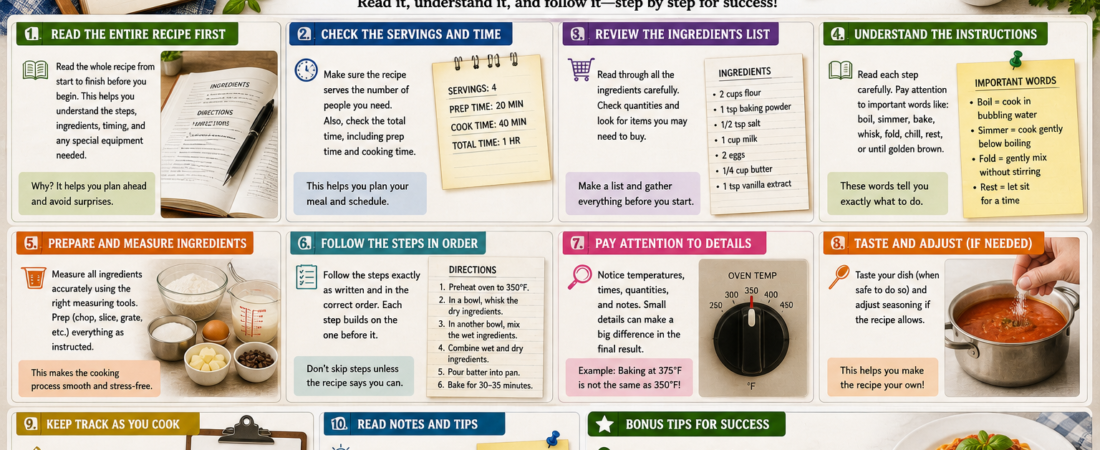
Learning how to read and follow a recipe correctly is one of the most useful skills for anyone who wants to become more confident in the kitchen. A recipe is more than just a list of ingredients. It is a set of instructions designed to help you prepare a dish in the right order, at the right temperature, and with the right amounts.
Whether you are cooking a simple meal or trying a complicated dish for the first time, taking the time to understand the recipe before you begin can prevent mistakes and make the entire cooking process easier.
Many beginners make the mistake of starting to cook immediately after looking at the ingredient list. They may later discover that an ingredient needed to be prepared in advance or that the oven should have been preheated. Reading the complete recipe first can save you from these problems.
1. Read the Recipe From Beginning to End
The first step is simple: read the entire recipe before you start cooking.
Do not only look at the ingredients.
Read every instruction carefully so you know what the recipe requires from beginning to end.
Some recipes include steps that take extra time. For example, meat may need to marinate, dough may need to rest, or a dish may need to chill before serving.
Knowing these requirements ahead of time allows you to plan properly.
2. Check the Number of Servings
Look at how many people the recipe is designed to serve.
A recipe might be written for two, four, six, or more people.
If you are cooking for a different number of people, you may need to adjust the ingredient quantities.
For example, if a recipe serves four people but you want to cook for eight, you may need roughly twice the ingredients.
However, not every ingredient should always be doubled automatically, especially salt, spices, or ingredients that strongly affect flavor.
For beginners, following the original recipe is often the easiest option until they become more comfortable with adjusting quantities.
3. Understand the Ingredient List
Before cooking, go through the ingredient list carefully.
Check that you have everything required.
Pay attention to details such as the type and condition of an ingredient.
For example, a recipe might call for softened butter rather than melted butter, fresh herbs rather than dried herbs, or cooked rice rather than uncooked rice.
These differences can affect the final result.
If you do not understand an ingredient, look it up before you begin rather than guessing.
4. Pay Attention to Measurements
Recipes can use different measurement systems.
You may see measurements such as teaspoons, tablespoons, cups, grams, milliliters, or liters.
Make sure you understand what each measurement means.
A teaspoon is not the same as a tablespoon, and a milliliter is not the same as a liter.
When baking, accurate measurements are especially important because changing the proportions of ingredients can affect texture and structure.
Using proper measuring cups, spoons, or a kitchen scale can help.
5. Notice Preparation Instructions
Ingredient lists often include preparation instructions.
For example, you might see:
- 1 onion, finely chopped
- 2 carrots, sliced
- 3 cloves of garlic, minced
- 500 g chicken, cut into pieces
The preparation description matters.
“Chopped,” “sliced,” “diced,” and “minced” describe different ways of cutting food.
The size of the pieces can affect how quickly they cook.
Before turning on the stove, prepare ingredients according to the recipe so they are ready when needed.
6. Understand Cooking Terms
Recipes often use cooking words that beginners may not immediately understand.
Terms such as sauté, simmer, boil, broil, fold, whisk, and knead each describe a particular action.
For example, simmering means cooking a liquid gently at a temperature below a full boil.
Sautéing generally involves cooking ingredients relatively quickly in a small amount of fat.
If you come across a cooking term you do not understand, take a moment to learn what it means.
Understanding the language of recipes becomes easier with practice.
7. Follow the Order of the Steps
The order of a recipe usually matters.
Recipes are written in a sequence for a reason.
If the instructions say to heat the oil before adding the onions, follow that order.
If the recipe tells you to add ingredients gradually, do not necessarily put everything into the pan at once.
Changing the order can affect cooking time, texture, and flavor.
Once you become an experienced cook, you may learn when certain steps can be changed, but beginners should generally follow the instructions closely.
8. Pay Attention to Cooking Temperatures
Temperature is one of the most important parts of cooking.
A recipe may tell you to cook something over low, medium, or high heat.
For baking, it may provide a specific oven temperature.
Use the recommended temperature whenever possible.
Cooking at a temperature that is too high can cause food to burn on the outside while remaining undercooked inside.
Cooking at a temperature that is too low may result in food taking much longer to cook or developing a different texture.
9. Understand Cooking Times
Recipes usually provide estimated cooking times.
However, cooking time is not always exact.
The size of your ingredients, the type of cookware you use, the strength of your stove, and the temperature of your ingredients can all affect how quickly food cooks.
Use the recipe’s time as a guide, but also check the food itself.
Look for signs of doneness such as color, texture, tenderness, or internal temperature when appropriate.
10. Prepare Everything Before You Start
One of the best ways to follow a recipe successfully is to prepare your ingredients before cooking.
This means washing and cutting vegetables, measuring spices, preparing sauces, and getting your equipment ready.
Professional chefs often use the French term mise en place, which means putting everything in its place.
You do not need to organize your kitchen like a restaurant.
Simply having the ingredients ready can make cooking much easier.
11. Don’t Rush Through Instructions
Recipes sometimes contain small details that are easy to miss.
Words such as “gradually,” “gently,” “until smooth,” “until golden brown,” or “let it rest” can make a significant difference.
Read each instruction carefully.
If a recipe says to stir continuously, do not walk away from the stove.
If it says to let something rest for ten minutes, do not immediately cut or serve it.
Small details often separate a successful dish from a disappointing one.
12. Know When to Taste
For many savory dishes, tasting during cooking can help you adjust the seasoning.
If the recipe allows it and the food is safe to taste, check the flavor before serving.
You may discover that it needs more seasoning, acidity, or another ingredient.
However, be careful when tasting foods that contain raw meat, raw eggs, or other ingredients that should not be consumed before cooking.
Food safety should always come first.
13. Avoid Unnecessary Substitutions
It can be tempting to replace ingredients when you do not have exactly what the recipe requests.
Sometimes substitutions work well, but sometimes they can completely change the dish.
For example, replacing one type of flour with another can affect a baked product.
Changing a liquid ingredient may also alter the texture.
If you need to make a substitution, understand how the replacement behaves before using it.
When you are still learning, following the original recipe is usually the best way to understand how the dish is supposed to turn out.
14. Use the Right Equipment
Read the recipe to see what equipment you need.
You may need a frying pan, saucepan, baking tray, mixing bowl, whisk, knife, blender, or measuring scale.
Having the correct equipment ready prevents interruptions.
If a recipe requires a particular type of pan, understand why it might be recommended.
Different cookware materials and sizes can affect how food heats and cooks.
15. Learn to Recognize Doneness
Do not rely only on the timer.
Learning what properly cooked food looks and feels like is an important cooking skill.
Vegetables may become tender.
Meat may reach a safe internal temperature.
Bread may become golden and sound hollow when tapped.
Sauces may thicken.
These visual and physical signs can help you determine whether your food is ready.
For foods where food safety is especially important, use a food thermometer rather than relying only on appearance.
16. Clean as You Go
Following a recipe does not mean you have to wait until the end to clean everything.
If you finish using a bowl or utensil, wash it or place it where it can be cleaned later.
Clear away food packaging and scraps.
A reasonably tidy workspace makes it easier to concentrate.
It also gives you more space to work.
17. Don’t Be Afraid to Ask Questions
If you are unsure about a step, do not simply guess.
Look up the cooking term, check a reliable cooking resource, or ask someone with experience.
Learning why a recipe asks you to perform a particular step can help you become a better cook.
Over time, instructions that once seemed confusing will become familiar.
Common Mistakes Beginners Make
Several mistakes happen frequently when people are learning to follow recipes.
One is failing to read the complete recipe before cooking.
Another is misreading measurements.
Some people also forget to preheat the oven or prepare ingredients before starting.
Others cook at the wrong temperature or rely entirely on the stated cooking time without checking the food.
Avoiding these mistakes becomes easier when you slow down and stay organized.
Final Thoughts
Knowing how to read and follow a recipe correctly can make cooking much less intimidating.
Start by reading the entire recipe before you begin. Check the servings, gather your ingredients, understand the measurements, prepare your food, and make sure you have the necessary equipment.
During cooking, follow the steps in order and pay attention to temperatures, cooking times, and descriptions of how the food should look or feel.
Remember that recipes are guides, not magic formulas. As you gain experience, you will become better at recognizing when food needs more time, when seasoning needs adjustment, and when a particular step can be adapted.
For beginners, however, the best approach is to follow the recipe carefully and learn from the results.
Every meal you prepare gives you an opportunity to understand ingredients, techniques, timing, and flavor a little better.
With practice, reading a recipe will become almost automatic. Instead of feeling like a complicated set of instructions, it will become a simple roadmap that guides you from your ingredients to a finished meal.